
Welcome to Worldia, we have over 25 years of expertise.

2026 Best Corrugated Suction Hose Types for Global Buyers

Selecting the best Corrugated Suction Hose in 2026 requires more than comparing prices or wall thickness. Global buyers now evaluate flexibility, vacuum resistance, abrasion life, temperature range, and material compatibility. A hose that performs well on a farm may fail inside a chemical plant. That difference matters.

Industry forecasts support this wider view. Grand View Research identifies industrial hose demand as closely linked to construction, agriculture, mining, manufacturing, and fluid handling. MarketsandMarkets also highlights rising demand for lightweight, flexible, and durable hose assemblies across industrial applications. However, these reports use different market definitions. Their estimates should guide planning, not replace technical verification.

In practical purchasing, PVC corrugated hose often suits water, irrigation, and general material transfer. Rubber designs provide stronger abrasion resistance for demanding service. TPU and specialized thermoplastic hoses can reduce weight while supporting granular products or aggressive handling. Food and pharmaceutical buyers need documented materials, traceability, and suitable hygiene standards. Chemical users must check permeation data, temperature limits, and coupling integrity.

Small details decide performance. A crushed bend near a pump inlet can restrict flow within minutes. A poorly matched camlock may leak under movement. Experience also shows that “universal” rarely means universal. Buyers should request pressure and vacuum ratings, bend-radius data, test methods, certificates, and installation guidance from qualified suppliers. ISO, EN, FDA, and other applicable requirements may influence selection, depending on the destination and application. This guide compares major hose types for global purchasing decisions, while recognizing one uncomfortable truth: the cheapest option can become the most expensive after downtime, contamination, or early replacement.
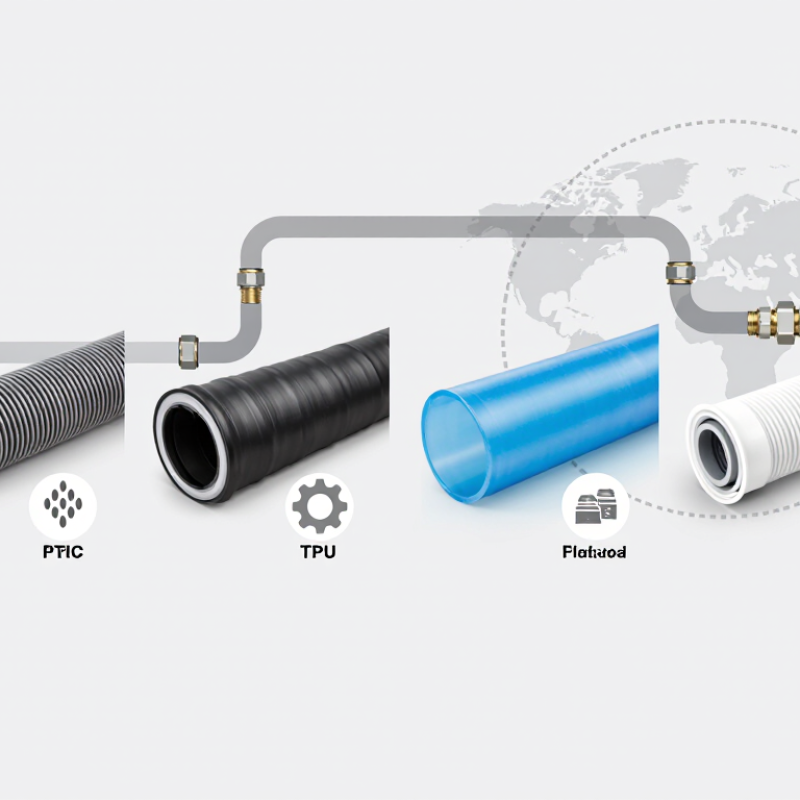
2026 Best Corrugated Suction Hose Types for Global Buyers

Corrugated Suction Hose: Definition, Structure, and Core Functions

2026 Best Corrugated Suction Hose Types for Global Buyers

Corrugated suction hose is a flexible tube designed to move liquids, slurries, air, or light solids under suction. Its outer wall has spiral or ring-shaped corrugations. These ribs improve flexibility while supporting the hose against collapse. The inner tube usually uses smooth or semi-smooth rubber, PVC, or thermoplastic material. Each material changes chemical resistance, weight, temperature range, and service life.

The structure includes an inner lining, reinforcement layer, corrugated cover, and connection ends. Reinforcement may contain textile, wire, or rigid helical support. Clear sections can help operators observe flow and detect blockages.

In field inspections, poor coupling often causes more failures than the hose body. That detail is easy to miss.

Core functions include transferring water, draining tanks, loading liquids, and handling abrasive mixtures.

A wire-reinforced type suits deeper suction and heavier vacuum conditions. A lightweight thermoplastic type often fits portable pumps and agricultural equipment.

No single type works everywhere.

Tips: Check working pressure, vacuum rating, temperature, chemical compatibility, and bend radius together. Measure the actual inner diameter, not only the fitting size. Keep the hose away from sharp edges and excessive twisting. A larger diameter may reduce friction, but it can increase handling difficulty. Selection charts help, yet real site conditions still deserve careful review.

Main Types of Corrugated Suction Hoses for Different Applications

Main Types of Corrugated Suction Hoses for Different Applications

Corrugated suction hoses are selected by material, pressure, temperature, and media. Each type solves a different handling problem. General-purpose PVC hoses suit water, light powders, and irrigation systems. They remain flexible and relatively easy to install. However, sharp bends can reduce their service life.

Thermoplastic rubber hoses handle rougher job sites and repeated movement. Their flexibility helps on mobile pumps, construction equipment, and drainage systems. Polyurethane hoses work well with abrasive materials, such as granules and fine powders. They resist wear better than many standard PVC options. For chemical transfer, specialized chemical-resistant hoses are safer. Compatibility must be checked against the exact liquid, temperature, and concentration.

Food and pharmaceutical processing may require smooth inner surfaces, hygienic materials, and traceable specifications. Anti-static or conductive hoses are useful where static charge could affect sensitive operations. They need correct grounding and installation. Corrugation improves bending performance, but it can also create cleaning challenges. This detail is often underestimated.

In field inspections, I have seen buyers choose by diameter alone. That approach often fails. A hose may fit the connection but collapse under suction. Check vacuum ratings, reinforcement, wall thickness, and bend radius together. Testing conditions should match real use. A small mismatch can become expensive. There is no universal best type. Even experienced buyers should review actual operating data before ordering.

How to Compare Hose Materials, Sizes, Flexibility, and Performance

2026 Best Corrugated Suction Hose Types for Global Buyers

Choosing a corrugated suction hose starts with the material, not the price. PVC hoses are light, economical, and suitable for water, dust, and general transfer. Thermoplastic rubber offers better flexibility in cold or uneven working areas. Polyurethane handles abrasion well when sand or sharp particles move through the line. Reinforced rubber remains useful for demanding suction and higher temperature conditions. Always check chemical compatibility. A hose can look strong and still fail internally.

Size affects flow, weight, and pump efficiency. Match the inner diameter with the equipment connection and required flow rate. A smaller hose may restrict material movement and increase energy use. A larger hose may become heavy and difficult to control. Corrugation improves bending, but every hose has a minimum bend radius. Measure the actual installation space. Do not rely only on catalogue drawings.

Performance depends on more than pressure ratings. Check vacuum resistance, temperature range, abrasion resistance, wall thickness, and coupling security. Clear walls can help operators spot blockages, although sunlight may shorten service life. In field inspections, loose clamps and overstretched bends often cause earlier failures than material defects. That detail is easy to miss. A practical warning. Test a sample under real flow conditions before placing a large order. Some specifications appear impressive, but they may reflect ideal laboratory conditions rather than daily handling. Examine loading, storage, cleaning, and replacement needs together. A cheaper hose is not always cheaper in operation.

2026 Best Corrugated Suction Hose Types for Global Buyers

A practical comparison of common hose materials, temperature capability, flexibility, chemical resistance, and typical applications.

Material Comparison

Hose Material Typical Maximum Continuous Temperature Flexibility Key Strength Common Use
PVC Up to approximately 60°C High Low cost and good general-purpose performance Water, air, light-duty material transfer
TPU / Polyurethane Up to approximately 80°C Very high Excellent abrasion and flex-fatigue resistance Dust, granules, powders, and abrasive particles
EPDM Rubber Up to approximately 120°C Medium Strong weathering, ozone, and hot-water resistance Water, air, steam-related low-pressure applications
PTFE Up to approximately 260°C Low to medium Very high chemical and temperature resistance Aggressive chemicals, solvents, and high-temperature media

The temperature values are representative continuous-service benchmarks for common material families. Actual limits depend on wall thickness, reinforcement, pressure, vacuum level, media, and end connections. TPU is usually preferred when flexibility and abrasion resistance are priorities, while PTFE is selected for demanding chemical or high-temperature service. Always confirm the supplier's pressure, vacuum, bend-radius, and temperature ratings before final selection.

Key Selection Criteria for Global Buyers and Industry Standards

2026 Best Corrugated Suction Hose Types for Global Buyers

Key Selection Criteria for Global Buyers and Industry Standards

Choosing a corrugated suction hose requires more than checking diameter and price. The conveyed medium, working temperature, vacuum level, and installation space must match the hose design. A flexible hose may bend easily, yet collapse under strong suction. That failure can stop a transfer line within minutes.

Start with the application. PVC and thermoplastic hoses suit many water, air, and light chemical duties. Rubber constructions often provide stronger abrasion resistance and better flexibility in demanding environments. Check the hose’s working pressure, vacuum rating, burst pressure, and minimum bend radius. These figures should appear on technical documents, not only marketing pages. Ask for batch traceability and test records.

Standards matter, but they need careful reading. ISO 1307 addresses hose dimensions and tolerances, while other standards cover specific media, temperatures, or suction and discharge duties. A claimed standard does not automatically prove chemical compatibility. Request the exact standard edition and test conditions. For conductive applications, verify electrical resistance and grounding requirements. For food, pharmaceutical, or potable-water service, confirm the relevant contact-material requirements for the destination market.

Global buyers should also inspect coupling quality. A reliable hose can still leak when clamps, gaskets, or fittings are poorly matched. Measure the actual hose outside diameter. Do not rely on nominal size alone. In field checks, improper storage is often overlooked; sharp folds and prolonged sunlight can weaken reinforcement before installation. Some selection decisions remain uncertain, especially when fluids change seasonally. Testing a sample under real suction conditions may prevent an expensive mistake.

2026 Best Corrugated Suction Hose Types for Global Buyers - Key Selection Criteria for Global Buyers and Industry Standards

Hose Type Typical Construction Typical Inside Diameter Range Typical Temperature Range* Typical Working Pressure at 20 °C* Main Advantages Common Applications Key Limitations
PVC Helix-Reinforced Suction Hose Flexible PVC wall with an embedded rigid PVC spiral 25–300 mm Approximately −20 to +60 °C Commonly 2–6 bar, depending on diameter and construction Lightweight, economical, transparent options available, good flexibility Water transfer, irrigation, dewatering, light-duty powders and granules Lower temperature, abrasion and chemical resistance than rubber or TPU designs
Soft PVC Suction and Delivery Hose Soft PVC tube reinforced with an external or embedded spiral 19–200 mm Approximately −15 to +60 °C Commonly 2–5 bar Good handling, smooth inner bore, suitable for general-purpose transfer Agricultural water, construction pumps, tanks and non-critical liquid transfer Plasticizers and PVC formulation must be checked for food, oil or chemical service
TPU Suction Hose Thermoplastic polyurethane tube with a steel or polymer helix 25–300 mm Approximately −40 to +90 °C Commonly 2–8 bar High abrasion resistance, good flexibility and strong resistance to many oils Abrasive powders, pellets, grain, dust extraction and material conveying Usually more expensive than PVC; hydrolysis, heat and chemical compatibility require review
EPDM Rubber Suction Hose EPDM rubber tube with textile reinforcement and a helical wire 25–300 mm Approximately −40 to +120 °C Commonly 3–10 bar Excellent weathering, ozone and hot-water resistance Hot water, cooling systems, dilute chemicals and outdoor industrial service Generally unsuitable for petroleum oils and many hydrocarbon fuels
NBR Rubber Suction Hose Nitrile rubber tube with textile reinforcement and an anti-static helix 25–300 mm Approximately −30 to +80 °C Commonly 3–10 bar Good resistance to mineral oils, fuels and many hydraulic fluids Fuel transfer, oil suction, lubricants and industrial fluid handling Limited resistance to ozone, weathering, concentrated acids and some solvents
Food-Contact PVC or TPU Suction Hose Hygienic polymer tube with a smooth bore and embedded spiral 25–250 mm Typically −25 to +80 °C; verify product-specific limits Commonly 2–6 bar Cleanable bore, low odor options and traceable food-contact materials Liquid food, beverage, pharmaceutical and hygienic powder transfer Food-contact compliance applies to the exact formulation and intended conditions only
Anti-Static or Electrically Conductive Suction Hose Polymer or rubber tube with conductive material and a grounded helix 25–200 mm Typically −30 to +80 °C Commonly 2–8 bar Helps dissipate electrostatic charge during powder or liquid transfer Combustible dust control, solvent handling and industrial extraction Grounding continuity, electrical resistance and hazardous-area requirements must be verified
Composite Suction Hose Multiple thermoplastic, fabric and metallic barrier layers with an outer cover 25–300 mm Often −30 to +100 °C; application-specific Commonly 5–15 bar Lightweight for its pressure rating, flexible and adaptable to chemical service Chemical loading, fuel transfer, marine service and bulk liquid handling Layer compatibility, permeation, bend radius and inspection procedures are critical

Key Selection Criteria for Global Buyers

Selection Dimension What to Confirm Before Purchase Recommended Buyer Action
Medium Compatibility Chemical concentration, viscosity, temperature, oil content, food-contact status and permeation risk Request a chemical-resistance statement for the exact hose lining and operating conditions
Vacuum and Pressure Full vacuum requirement, positive pressure, surge pressure and operating temperature Use the manufacturer’s rating tables; do not treat working pressure as burst pressure
Diameter and Flow Required flow rate, connection size, allowable pressure loss and particle size Select the inside diameter based on flow calculations, not only the nominal fitting size
Bend Radius and Flexibility Minimum dynamic and static bend radius, routing space and repeated movement Specify the minimum bend radius and inspect for kinking during installation
Abrasion and Impact Particle hardness, conveying speed, external dragging and service frequency Prefer TPU or reinforced rubber constructions for severe abrasive service
Electrical Safety Static-charge risk, grounding path, surface resistance and hazardous-area classification Specify anti-static or conductive construction and verify continuity after installation
Fittings and Assembly Thread or flange standard, coupling material, clamp method, gasket compatibility and pull-off resistance Approve the complete hose assembly, not only the tube specification
Documentation and Traceability Material declaration, test report, batch identification, operating limits and inspection instructions Require batch traceability and technical documentation in the purchase specification

Commonly Referenced Standards and Compliance Areas

Standard or Compliance Area Relevant Scope Buyer Verification Point
ISO 1307 Rubber and plastics hoses; hose sizes, inside diameters and tolerances Confirm nominal size and dimensional tolerances against the applicable product specification
ISO 3862 Rubber hose assemblies with wire or textile reinforcement for hydraulic applications Use only when the hose design and intended hydraulic service fall within the standard’s scope
EN 12115 Rubber and thermoplastics hoses for liquid or gaseous chemicals Check chemical type, temperature, pressure, electrical properties and assembly marking
EN 1765 Rubber hose assemblies for oil suction and discharge service Confirm the product is specifically designed and tested for oil suction or discharge duty
Food-Contact Regulations Material suitability for food and beverage contact in the destination market Check the applicable requirements, such as EU food-contact rules or U.S. FDA requirements, for the exact formulation
ATEX and IECEx-Related Requirements Equipment and working environments where explosive atmospheres may exist Verify the complete system’s hazardous-area assessment, grounding and electrostatic-control requirements
REACH and RoHS Declarations Chemical-substance and restricted-substance reporting for applicable markets Request current declarations for the hose, reinforcement, fittings and supplied accessories

*Performance ranges are representative purchasing guidelines rather than universal ratings. Actual limits depend on inside diameter, wall thickness, reinforcement, vacuum level, temperature, medium, bend radius, fittings and the manufacturer’s tested data. Always use the applicable technical datasheet for final selection.

Storage, Installation, Maintenance, and Safe Use Requirements

2026 Best Corrugated Suction Hose Types for Global Buyers

Storage, Installation, Maintenance, and Safe Use Requirements

Corrugated suction hoses may use reinforced PVC, rubber, or polyurethane construction. Each type serves different temperature, flexibility, and abrasion needs. Store hoses indoors, away from direct sunlight, solvents, sharp edges, and standing water. Keep them loosely coiled on a clean support. Tight bends can flatten the corrugations and weaken reinforcement.

Installation requires careful alignment. Never use the hose to correct pipe misalignment. Support heavy connections separately, especially near pumps and tank outlets. Check that the hose diameter matches the system connection. Clamps should sit evenly behind the hose bead, not across a corrugated peak. Overtightening can crush the wall. It happens more often than expected.

Before operation, inspect the cover, helix, couplings, and sealing surfaces. Look for cuts, soft areas, exposed wire, unusual swelling, or permanent kinks. A clean appearance proves little. Flush the hose with a compatible medium, then drain it fully before storage. Do not drag it over concrete. Do not exceed its rated vacuum, pressure, temperature, or bending radius. Suction service can collapse a hose without obvious external damage. Secure the assembly against whipping if a connection fails. Operators should wear suitable eye and hand protection and follow the equipment maker’s instructions. Record inspection dates, but keep judgment involved; checklists can miss gradual stiffness or hidden reinforcement damage.

Hi! What is your idea today?
WORLDIA 8618618272087
Nina +86 15631662072
google-site-verification=0STkOZEvYuoDp-D40AVfMUk--CzM2AsZv24S6ISPdmk