
Choosing the right Puree Pouch Filling Machine affects product consistency, production speed, and daily operating costs. Global buyers often compare equipment by pouch format, filling accuracy, sealing method, and automation level. This guide introduces ten practical machine types for fruit puree, vegetable blends, baby food, sauces, and similar semi-liquid products.
Each type serves a different factory reality. Rotary machines can support high-volume production, while linear models may suit growing facilities with limited floor space. Servo-driven systems usually provide accurate dosing and smoother adjustments. Piston fillers handle thicker purees well, but pump-based designs may work better with products containing small particles. Heat-sealing units need stable temperature control, clean sealing surfaces, and dependable pouch positioning.
Small details matter. A leaking corner can ruin an entire carton. A narrow filling nozzle may slow cleaning. An oversized hopper can increase waste during product changes. Experienced buyers should inspect contact materials, cleaning access, nozzle design, control interfaces, and spare-parts support. Machine testing with the actual puree is strongly recommended because laboratory assumptions sometimes fail on the factory floor.
The comparison also considers output range, pouch compatibility, maintenance demands, and operator skill. Not every advanced machine is the best investment. Sometimes, a simpler model offers greater reliability. Product viscosity can change with temperature, which deserves careful attention. Clear technical documentation, responsive suppliers, and recorded performance data help reduce uncertainty. These points provide a practical foundation for evaluating the top ten Puree Pouch Filling Machine types across different production environments.
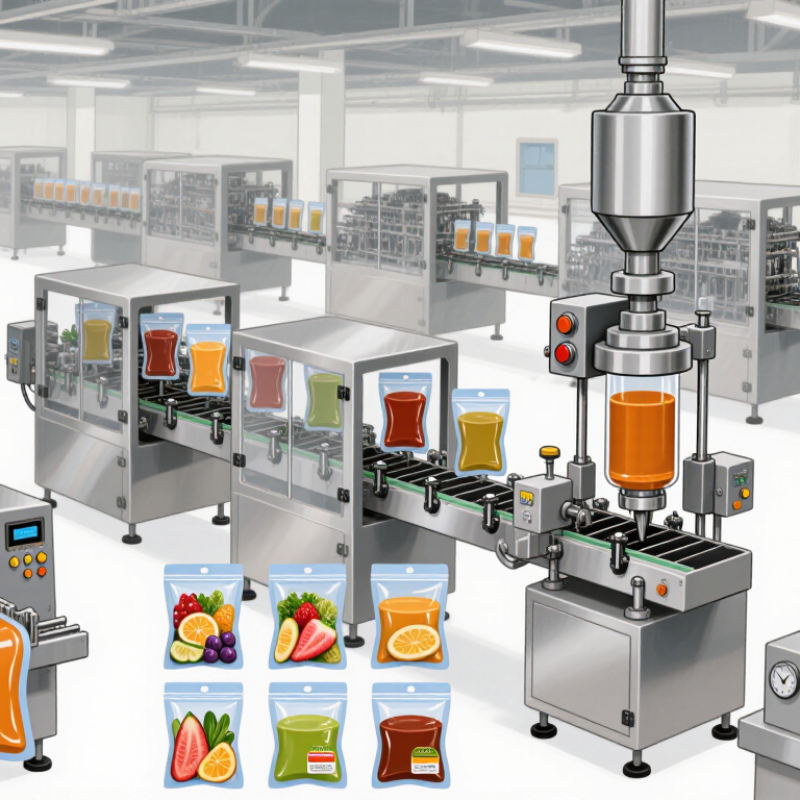
Puree pouch filling machines are automated systems that measure, dispense, and seal fruit, vegetable, or baby-food purees. They support consistent portion control while reducing spills, labor, and product exposure. Global buyers may encounter rotary, linear, premade-pouch, vertical form-fill-seal, and multi-lane designs. Each type suits different pouch materials, output targets, and factory layouts.
The main components include a sanitary product hopper, an agitator, a dosing pump, and filling nozzles. The agitator helps prevent settling when puree contains fibers or small particles. Positive-displacement pumps often handle thick products more steadily than basic liquid pumps. A pouch holder keeps the package stable during filling. Heat-sealing jaws then close the pouch under controlled temperature, pressure, and dwell time.
A PLC manages filling volume, sealing cycles, alarms, and sensor feedback. Many systems also include clean-in-place connections, although cleaning performance depends on real piping design. That detail is often underestimated. In practical evaluations, I check nozzle accuracy, changeover time, seal strength, and access to food-contact surfaces. A machine that runs quickly but cleans poorly can create costly downtime. No machine is perfect. Product temperature, viscosity, and pouch variation can still affect results. Buyers should request trials using their actual puree, packaging film, and target fill weight before approving a final specification.
Top 10 Puree Pouch Filling Machine Types for Global Buyers
Ten Main Machine Types Classified by Filling Method and Pouch Design
Puree pouch equipment is best compared by filling method and pouch structure. Grand View Research valued the global flexible packaging market at about USD 265.9 billion in 2023. This growth increases demand for cleaner, faster pouch systems. The ten main types include gravity fillers, overflow fillers, piston fillers, servo-piston fillers, lobe-pump fillers, and mass-flowmeter fillers. The pouch-focused group includes premade spouted pouch fillers, premade flat-pouch fillers, vertical form-fill-seal machines, and horizontal form-fill-seal machines for shaped or retort pouches.
Thick apple puree usually needs piston or lobe-pump filling. These systems handle higher viscosity with controlled dosing. Servo pistons improve accuracy and recipe changeovers. Thin vegetable puree may suit gravity or overflow filling. Mass-flowmeter systems provide useful control when density changes. Premade spouted pouch machines reduce forming steps. VFFS machines save film costs, while HFFS systems create cleaner shaped pouches. PMMI’s 2024 packaging machinery report highlights strong investment in automation, hygiene, and flexible packaging formats. However, higher speed is not always better. Poor deaeration can leave air near the seal.
Tips: Test the actual puree at production temperature. Measure viscosity, particles, pouch width, seal strength, and target fill weight. Ask for a long trial, not only a short demonstration. Operators often notice problems that specifications miss. A perfect machine list does not exist. Your puree and pouch film decide the final choice.
| Rank | Machine Type | Filling Method | Pouch Design | Suitable Puree Characteristics | Typical Fill Range | Typical Output Range | Typical Filling Accuracy | Common Applications | Main Buyer Considerations |
|---|---|---|---|---|---|---|---|---|---|
| 1 | Servo Piston Filler for Premade Spout Pouches | Servo-driven piston dosing | Premade stand-up pouch with top or corner spout | Low-to-high viscosity fruit, vegetable, baby-food and dessert purees | 80–2,000 g | Approximately 20–70 pouches/min, depending on pouch size and filling volume | Typically within ±0.5% to ±1.0% of the target weight | Baby food, fruit puree, tomato puree, smoothie puree and food-service packs | Offers accurate dosing and good recipe changeover; check piston diameter, hygienic design and spout sealing compatibility |
| 2 | Pneumatic Piston Filler for Premade Spout Pouches | Air-operated piston dosing | Premade spouted stand-up pouch | Medium-viscosity puree with consistent texture and limited particulate content | 100–1,500 g | Approximately 15–50 pouches/min | Typically within ±1.0% to ±2.0% of the target weight | Retail puree, sauces, custard, fruit preparations and institutional food packs | Simple and economical; requires stable compressed air and careful adjustment when product viscosity changes |
| 3 | Rotary Premade-Pouch Filler with Servo Piston Stations | Multi-station piston filling | Premade flat, three-side-seal or stand-up pouch | Homogeneous purees requiring repeatable high-cycle dosing | 50–1,500 g | Approximately 40–120 pouches/min, depending on the number of filling lanes and stations | Typically within ±0.5% to ±1.0% | Medium- and large-scale retail production of fruit and vegetable purees | High automation and consistent pouch handling; requires compatible pouch dimensions and regular changeover planning |
| 4 | Premade Flat-Pouch Filler with Servo Pump | Servo-controlled sanitary pump | Premade three-side-seal or four-side-seal flat pouch | Free-flowing to medium-viscosity puree, including heat-treated products | 30–500 g | Approximately 30–100 pouches/min | Typically within ±1.0% to ±2.0% | Single-serve puree, snack packs, food samples and portion-controlled products | Compact package format and low material usage; confirm pump shear, product temperature and pouch seal width |
| 5 | Vertical Form-Fill-Seal Machine with Sanitary Pump | Continuous or intermittent pump filling | Film-formed pillow pouch or center-seal pouch | Low-to-medium viscosity puree without large particulates | 50–1,000 g | Approximately 25–80 pouches/min | Typically within ±1.0% to ±2.0% | Economical single-serve puree, sauces, cooking ingredients and institutional packs | Uses roll stock rather than premade pouches; evaluate film barrier, seal integrity and product-contact cleaning access |
| 6 | Vertical Form-Fill-Seal Machine with Piston Filler | Volumetric piston dosing | Film-formed pillow, gusseted or block-bottom pouch | Medium-to-high viscosity puree with stable density | 100–2,000 g | Approximately 20–60 pouches/min | Typically within ±1.0% to ±2.0% | Bulk puree, tomato products, thick fruit fillings and food-service packaging | Suitable for heavier products; confirm film forming-collar dimensions, piston capacity and the required headspace |
| 7 | Horizontal Form-Fill-Seal Sachet Machine with Piston Dosing | Intermittent piston filling | Film-formed three-side-seal or four-side-seal sachet | Low-to-medium viscosity puree for small portions | 5–150 g | Approximately 40–180 sachets/min, depending on lanes and pouch dimensions | Typically within ±1.0% to ±2.0% | Baby-food samples, tasting packs, travel portions and meal-kit ingredients | Efficient for small formats and multi-lane production; verify product cut-off control and seal contamination resistance |
| 8 | Horizontal Form-Fill-Seal Stick-Pouch Machine with Pump Filler | Pump dosing with film forming | Long narrow stick pouch or slim single-serve pouch | Pourable puree, smoothie base and thin fruit or vegetable preparations | 10–100 g | Approximately 60–240 pouches/min, depending on the number of lanes | Typically within ±1.0% to ±2.0% | On-the-go nutrition, sports food, beverage puree and convenience products | High production density; check pump inlet design, pouch opening performance and film stiffness |
| 9 | Premade Flat-Pouch Filler with Peristaltic Pump | Tube-based peristaltic dosing | Premade flat pouch or small stand-up pouch | Low-to-medium viscosity puree where gentle product handling and easy tube replacement are important | 10–500 g | Approximately 15–60 pouches/min | Typically within ±1.0% to ±2.0% | Short production runs, specialty puree, nutraceutical food and pilot-scale packaging | Product contacts only the disposable or replaceable tube; assess tubing compatibility, pulsation and maximum viscosity |
| 10 | Premade Spouted-Pouch Filler with Mass-Flow or Checkweigh Dosing | Flowmeter or gravimetric filling | Premade spouted stand-up pouch or large-capacity pouch | Products requiring tight weight control, including variable-density puree blends | 250–5,000 g | Approximately 10–45 pouches/min | Typically within ±0.2% to ±0.8%, depending on the weighing system and product flow | Family-size puree, food-service packs, export formats and premium products sold by net weight | Provides strong control of net content; requires stable product flow, accurate load cells and suitable pouch support during filling |
Note: The capacity, speed and accuracy figures are typical indicative ranges for commercial puree pouch packaging systems. Actual performance depends on puree viscosity, temperature, particle size, pouch dimensions, film structure, filling volume, sanitation requirements and local electrical standards.
Puree pouch demand is rising. Grand View Research’s 2024 pouch report forecasts over 5% annual growth through 2030. That growth increases pressure on dosing accuracy, hygiene, and sealing control.
Rotary premade-pouch machines pick, open, fill, seal, and discharge each pouch. Linear premade-pouch machines repeat those actions in a straight indexing line. Vertical form-fill-seal machines unwind film, form a tube, dose puree, seal, and cut.
Spouted pouch machines orient the pouch, insert the spout, fill, and cap it. Aseptic machines sterilize packaging, meter sterile puree, and seal inside controlled conditions.
Hot-fill machines heat the puree, fill measured volumes, seal immediately, then cool the package. Vacuum pouch machines remove trapped air before filling and sealing. Multi-lane machines divide puree across several dosing lanes and operate simultaneously. Piston fillers draw puree into cylinders, then discharge fixed volumes through nozzles. Servo-pump machines calculate each dose electronically, pump puree, and adjust speed during production.
The sequence sounds simple. It is not always smooth.
PMMI’s flexible-packaging research highlights automation, waste reduction, and flexible format changes as major industry priorities.
In practice, operators still check nozzle dripping, pouch wrinkles, and seal contamination. A thick mango puree may need gentle agitation, while a fibrous vegetable puree may require wider valves.
I would not trust a catalog speed alone. Real performance depends on viscosity, temperature, pouch structure, and cleaning discipline. Small errors become visible leaks.
Top 10 Puree Pouch Filling Machine Types for Global Buyers
Choosing among puree pouch filling machine types starts with the product, not the machine catalogue. A thick mango puree behaves differently from a chilled vegetable blend. Fibers, seeds, temperature, and viscosity affect pump selection and filling accuracy. During factory trials, measure pouch weight at startup, mid-run, and shutdown. Small errors become expensive across thousands of packs.
Hygienic design deserves close inspection. Look for stainless steel contact parts, tool-free access, smooth welds, and validated cleaning procedures. A machine should support the pouch sizes your market actually sells. Check filling speed, seal temperature control, oxygen exposure, and changeover time. Servo-driven systems may improve precision, but they can add maintenance skills and spare-part needs.
Global buyers also need dependable documentation. Request factory acceptance testing, electrical drawings, maintenance schedules, and traceability records. Confirm compatibility with local power standards and packaging materials. Remote support is useful, though it cannot replace trained operators on the production floor. Ask how failures are diagnosed at 2 a.m. That answer matters.
Do not trust advertised output alone. Test your real puree.
A practical evaluation should include several production conditions, including low temperature and high viscosity. Review the results with quality, engineering, and operators together. Their priorities may conflict. That is normal. The best choice often balances sanitation, accuracy, flexibility, service access, and total ownership cost rather than chasing the highest speed.
Top 10 Puree Pouch Filling Machine Types for Global Buyers
Puree pouch fillers must match product texture, pouch format, and local safety expectations. The ten common types include linear, rotary, intermittent, continuous, multi-lane, hot-fill, chilled, aseptic, spouted, and high-viscosity systems. Each requires different dosing control. A fruit puree may need gentle piston filling, while a thick vegetable blend may require servo-driven augers or vacuum assistance.
Food safety cannot be treated as a checklist. The World Health Organization estimates that contaminated food causes 600 million illnesses and 420,000 deaths annually. Therefore, buyers should examine hygienic welds, tool-free access, clean-in-place design, and controlled sealing temperatures. Equipment should support HACCP procedures and ISO 22000-based food safety systems. A failed seal can waste an entire batch.
Automation also affects international usability. The International Federation of Robotics recorded 541,302 industrial robot installations worldwide in 2023, showing continued investment in automated production. Pouch fillers now commonly offer servo dosing, vision inspection, recipe storage, remote diagnostics, and automatic film tracking. These features reduce operator variation, but they do not eliminate training needs. Not every factory needs maximum speed. Sometimes, simpler equipment is safer and easier to maintain. Buyers should verify electrical standards, language options, spare-part availability, and validation documents before purchase. That step is often underestimated. (Sources: WHO, Food Safety Fact Sheet; IFR, World Robotics 2024.)
Typical nominal filling speed by machine type, with emphasis on automation, hygiene, and international production needs
The values represent typical nominal output ranges for commonly used puree pouch configurations. Actual performance depends on pouch size, product viscosity, filling accuracy, sealing technology, cleaning requirements, and regional compliance expectations such as hygienic design, machine guarding, electrical safety, and food-contact regulations.
